The identity security conversation has shifted dramatically in the past twelve months. The industry has moved from asking “how do we manage passwords and SSO tokens for employees?” to confronting a much harder question: how do we govern the credentials of autonomous software agents that act on behalf of humans, operate at machine speed, and never sleep?
Cloud-based identity platforms are racing to answer this question at the infrastructure layer — extending access management to cover human, machine, and AI agent identities with just-in-time, dynamic, runtime controls. This is exactly the right instinct. But there’s a gap in the conversation that isn’t getting enough attention: the endpoint.
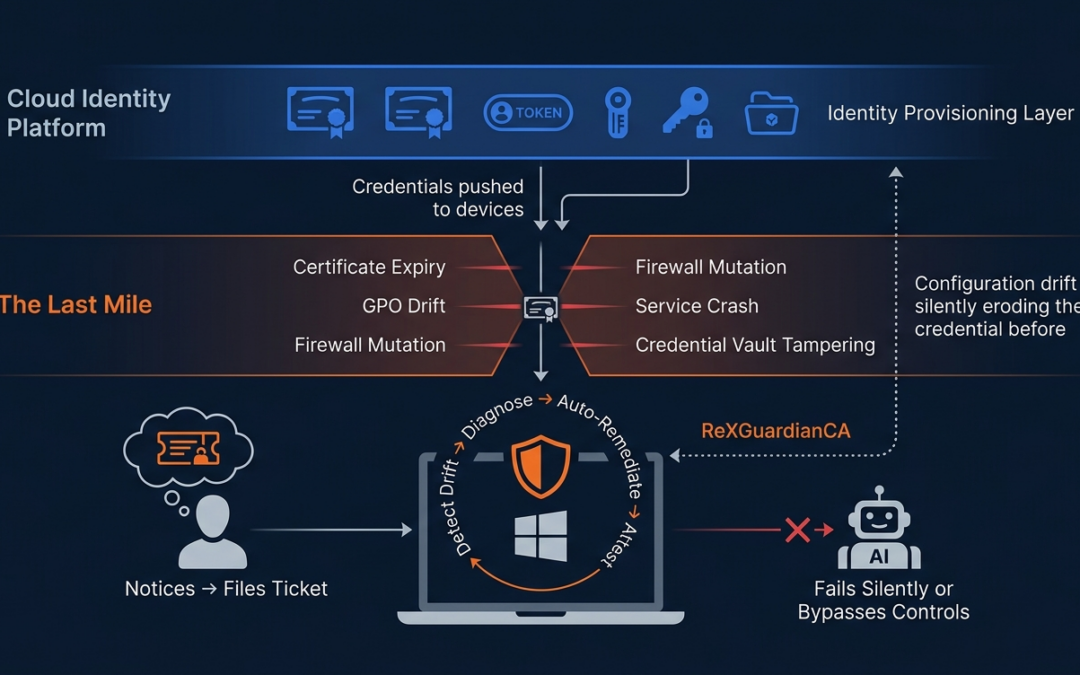
Every credential eventually lands on a device. Certificates get installed on laptops. VPN profiles get pushed to endpoints. API tokens get cached in local credential stores. Service accounts authenticate through agents running on physical or virtual machines. No matter how sophisticated the cloud-side identity platform, the actual consumption of that credential happens at the edge — and that’s where things quietly break.
This post explores what I’ve learned architecting ReXGuardianCA — the on-device AI connectivity assistant I designed at ReXLytics — about autonomous credential lifecycle management at the device layer, and why I believe endpoint-level credential governance is the critical last mile that cloud identity platforms will need to coordinate with as agentic AI scales.
The Credential Lifecycle Doesn’t End at Provisioning
Most identity platforms — rightfully — focus on the provisioning and authorization side: issuing the right credential to the right entity with the right scope at the right time. This is hard, important work, especially as organizations move toward ephemeral, just-in-time access models where credentials are scoped to a specific task and automatically revoked.
But provisioning is only half the story. Once a credential reaches a device, a second lifecycle begins — one governed by the realities of endpoint configuration, local system state, and environmental drift.
Consider what happens to a VPN certificate after it’s provisioned to a remote employee’s laptop:
The certificate has an expiration date. If the device is offline or asleep when renewal is due, it silently lapses. Group Policy updates can modify the local certificate store, sometimes removing or overwriting the certificate entirely. A firewall rule change — pushed by IT or triggered by a Windows update — can block the authentication flow that depends on that certificate. The cryptographic service that manages the credential store can crash or stop, leaving the certificate inaccessible even though it technically exists.
None of these failure modes originate from the identity platform. They originate from the endpoint. And in a world where that endpoint is used by an AI agent running autonomously — not a human who would notice the VPN icon turning red and call the help desk — these silent failures become silent security gaps.
What Configuration Drift Means for Non-Human Identities
The challenge compounds when the credential consumer is a non-human identity. A human user who can’t authenticate will eventually notice, get frustrated, and file a ticket. An AI agent that can’t authenticate might retry silently, fall back to a cached token, attempt an alternate path with broader permissions, or simply fail without surfacing the issue to anyone.
This is where configuration drift becomes particularly dangerous for agentic workflows. When I architected ReXGuardianCA, I designed it to continuously monitor the five critical layers of endpoint configuration that affect remote access connectivity: the certificate store, firewall rules, Group Policy objects, network interface state, and the local credential vault. The on-device AI pipeline uses Siamese network-based drift detection to compare real-time configuration snapshots against known-good baselines, identifying silent changes before they cause authentication failures.
What we’ve found in early enterprise deployments is sobering: configuration drift on endpoints is not occasional — it’s constant. Certificates expire. Services stop. GPO pushes conflict with each other. Firewall rules get clobbered by software updates. In a pilot across 5,000 hybrid-work endpoints, 93% of the connectivity issues that would have generated help desk tickets were caused by exactly these kinds of local configuration failures — and ReXGuardianCA was able to detect and auto-remediate them in under five seconds, before the user (or agent) was ever impacted.
Now imagine those 5,000 endpoints are also running AI agents that depend on locally-stored credentials to authenticate to enterprise services. The same drift that breaks a human’s VPN connection will break an agent’s ability to securely access the resources it needs to do its job. But unlike the human, the agent won’t call the help desk. It will either fail silently or — worse — find a workaround that bypasses the intended access controls.
Autonomous Credential Governance: What It Looks Like in Practice
ReXGuardianCA already performs what I think of as “autonomous credential lifecycle management at the edge.” I didn’t originally design it for the agentic AI use case — I designed it to keep remote employees connected without requiring help desk intervention. But the architectural pattern turns out to be directly applicable to non-human identity governance.
Here’s what it looks like concretely:
Automated certificate renewal. When ReXGuardianCA detects that an Always On VPN certificate is approaching expiration (or has already expired), it can autonomously initiate a renewal workflow — generating a new certificate signing request, submitting it to the organization’s internal Certificate Authority, installing the new certificate, and verifying that the VPN connection authenticates successfully. The entire process happens on-device, governed by policy, with full audit logging. No human intervention required.
Service health monitoring and self-healing. Critical Windows services that underpin credential operations (IP Helper, IKE/AuthIP, the certificate propagation service) can stop or crash without any visible symptom until an authentication attempt fails. ReXGuardianCA monitors these services continuously and can restart them automatically, with rollback capability if the restart causes unexpected side effects.
Policy-driven remediation with rollback. Every autonomous action ReXGuardianCA takes is governed by a policy framework. Administrators define which remediations can run silently, which require user approval, and which require IT authorization. Every change is backed up before execution and can be rolled back. Every action is logged with audit-ready evidence. This is the governance layer that makes autonomous endpoint operations safe for enterprise environments — and it’s the same governance model that will be essential for managing what AI agents are allowed to do with credentials on a device.
Drift detection as a continuous compliance signal. Rather than checking credential state only at authentication time, ReXGuardianCA continuously profiles the endpoint’s configuration posture. This creates a real-time signal that could be consumed by cloud-based identity platforms: “this device’s credential environment is healthy and matches the expected baseline” or “drift detected — certificate store has been modified since last known-good state.” This is the kind of endpoint attestation signal that runtime access control decisions should factor in.
The Last Mile Problem for Identity Platforms
The most capable identity platforms in the world — the ones that can dynamically provision scoped credentials for human, machine, and AI agent identities — still face a fundamental dependency: they need the endpoint to be in a healthy state to receive, store, and use those credentials correctly.
As the industry builds out cloud-scale identity infrastructure for the agentic era, we think three architectural principles will become essential:
First, endpoint credential health must become a first-class signal in access decisions. A cloud identity platform that provisions a certificate to a device should be able to verify that the certificate was correctly installed, that the services it depends on are running, and that no drift has occurred since provisioning. This requires an on-device agent that can attest to local credential state — not just at provisioning time, but continuously.
Second, autonomous remediation at the endpoint must be policy-governed and auditable. As AI agents proliferate, the volume of credential lifecycle events on each device will increase substantially. Human-in-the-loop remediation won’t scale. But fully autonomous remediation without governance is a security risk. The answer is the same pattern ReXGuardianCA uses today: policy-driven automation with rollback, least-privilege execution, and comprehensive audit logging.
Third, on-device intelligence must be privacy-preserving by design. An endpoint agent that monitors credential state has access to sensitive information — certificate details, service account names, authentication flows. The same privacy-first principles that drive server-side confidential computing (keeping sensitive operations isolated so that even the operator can’t observe them) must apply at the device layer. This conviction shaped one of my core architectural decisions for ReXGuardianCA: 100% local inference using on-device AI models (Microsoft Phi Silica and ONNX Runtime), with all diagnostic data encrypted via DPAPI-NG and zero telemetry shipped off-device by default. No cloud dependency means no data exposure — even to us as the vendor.
Where This Converges
The identity security industry is converging on a model where every entity — human, machine, or AI agent — has a governed identity with scoped, time-bound, dynamically controlled access. This is the right direction. The platforms being built to deliver this at cloud scale are solving genuinely hard problems around provisioning, authorization, and runtime access control.
But the endpoint is where those governed identities actually operate. It’s where credentials are stored, where authentication happens, where configuration drift silently erodes the guarantees that the identity platform established. As AI agents become first-class credential consumers — authenticating to enterprise services, managing secrets, and acting autonomously — the gap between “credential provisioned” and “credential healthy on the device” becomes a critical attack surface.
We believe the next phase of identity security requires a tight feedback loop between cloud-based identity platforms and intelligent endpoint agents that can continuously attest to local credential health, autonomously remediate drift, and do so within a policy-governed, privacy-preserving, auditable framework.
That’s what we’re building at ReXLytics with ReXGuardianCA. And we think it’s the last mile that will determine whether the promise of secure agentic AI actually holds up in production.
Emmett O'Brien is the CTO of ReXLytics, Inc. and the architect of ReXGuardianCA, an on-device AI connectivity assistant and security solution designed to diagnose, predict, and self-heal VPN, ZTNA, and VDI issues at the endpoint.. Learn more at ReXLytics.com or connect with Emmett O’Brien on LinkedIn.